


Are Survey Sites Scams? What Business Owners in Honolulu, HI Should Know
Survey sites promise easy money for a few minutes of your time, but Honolulu business owners who click without thinking can hand over passwords, tax IDs, or wire transfer details to criminals. The Federal Trade Commission warns that unexpected text messages asking you to complete surveys for free items are high-risk traps designed to steal information or install malware.
Before you or your employees answer another online quiz or fill out a customer satisfaction form, it helps to know which red flags separate a legitimate research tool from a phishing operation targeting Hawaii businesses.
Key takeaways from this article:
Unexpected survey texts are high-risk scams: the FTC advises never clicking links or responding to messages promising free items for completing surveys.
Online quizzes requesting personal information can be phishing scams designed to harvest credentials or install malware on business devices.
Fake government branding is common in Hawaii: scammers impersonate state agencies using official letterhead and spoofed sender addresses to appear legitimate.
Verifying any business through the Hawaii DCCA online lookup or by phone at (808) 587-4272 helps confirm whether a survey request comes from a real organization.
Why survey scams target busy business owners
Small business owners in Honolulu, HI receive dozens of messages daily: invoices, vendor quotes, customer requests, and regulatory notices. Scammers exploit this noise by embedding fake surveys that look like routine business communications.
The goal is not your opinion. It is your credentials, your financial data, or access to your network. A single employee clicking a malicious survey link can expose customer records, payroll systems, or proprietary business data.
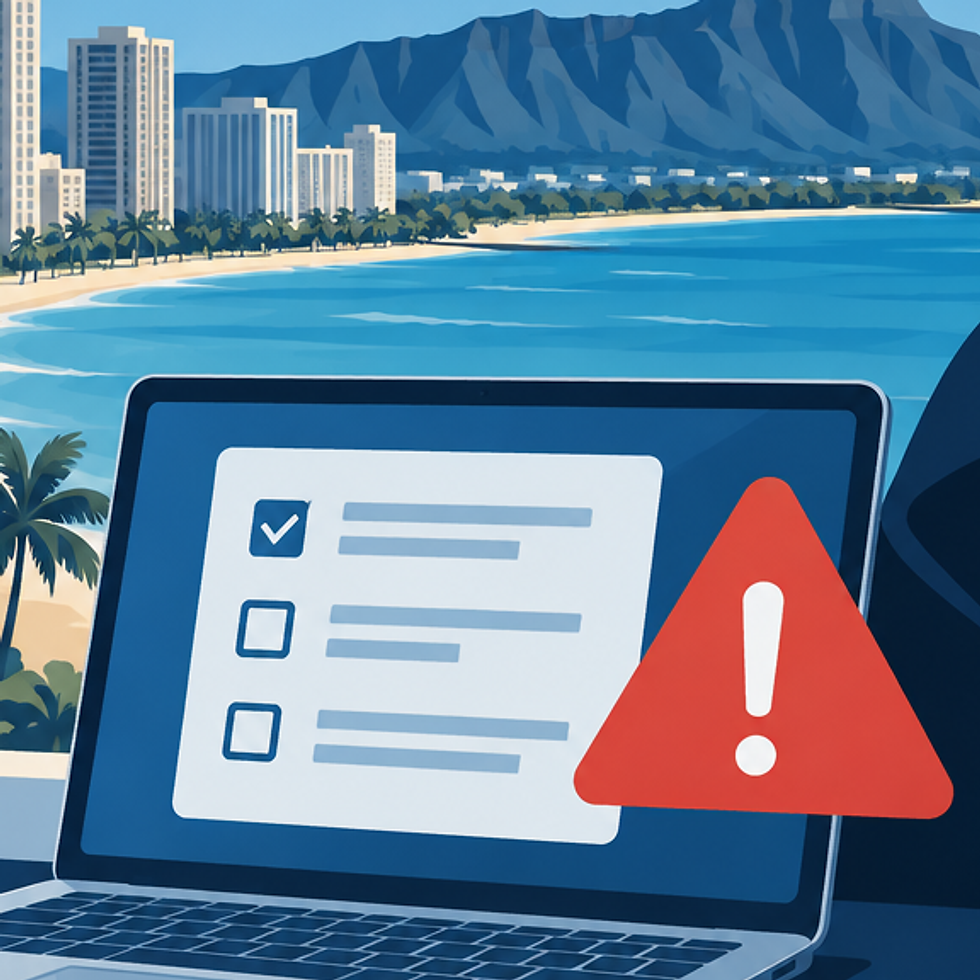
How unexpected survey texts become costly breaches
The FTC advises recipients not to click links or respond to unexpected texts, including messages asking them to complete surveys for free items FTC Consumer Advice. This guidance exists because criminals use urgency and small rewards to bypass rational judgment.
A text promising a free gift card for a two-minute survey seems harmless. Once you click, you may land on a credential-harvesting page or trigger a malware download that spreads across your business network. Honolulu businesses with bring-your-own-device policies face extra exposure when employees use personal phones for work email and messaging.
When online quizzes mask phishing attacks
The FTC warns that online quizzes can be phishing scams and recommends reporting suspected phishing to ReportFraud.ftc.gov. These quizzes often appear on social media or arrive through email with subject lines like "Test your business IQ" or "Which entrepreneur are you?"
Each question builds trust while extracting information. Your first pet, your high school mascot, and your mother's maiden name are common security questions. A quiz that collects three or four of these answers has assembled a skeleton key to your accounts.
Fake government branding and spoofed agency communications
Hawaii's Office of Consumer Protection reported phishing emails impersonating DCCA and using agency letterhead and a spoofed sender address. Scammers know that business owners hesitate to ignore messages that appear to come from regulators or tax authorities.
The Hawaii DCCA advises businesses receiving suspicious impersonation emails not to click links or download attachments. Branding alone proves nothing. Official letterhead, logos, and even correct phone numbers can be copied and pasted into a fraudulent message in minutes.
Practical steps to verify survey requests and protect your business
Before responding to any survey that claims government or corporate sponsorship, use the Hawaii DCCA online service for checking out a business. A two-minute verification can prevent a six-month recovery from identity theft or fraud.
Train employees to treat every unsolicited survey as suspicious until verified. Establish a simple protocol: forward the message to a designated security contact, never click embedded links, and verify the sender through an independent channel. For businesses without dedicated IT staff, this protocol becomes the front line of defense.
How Honolulu businesses can build resilient security habits
CyPac provides managed SOC services that help Hawaii businesses detect and respond to phishing campaigns, including survey-based attacks, without maintaining an internal security operations team. Our analysts monitor for suspicious link activity, credential compromise indicators, and malware callbacks across Oahu, Maui, Kauai, and the Big Island.
We publish educational cybersecurity content covering current threats such as infostealer malware, social engineering, and emerging attack techniques. Our team includes Attila and Mars, who serve as blog authors and cybersecurity educators focused on practical guidance for non-technical business readers.
For businesses evaluating their security posture, CyPac offers a 30-day free trial period as a low-barrier entry point. This allows Honolulu organizations to assess whether continuous monitoring and expert response fit their risk profile before committing to a longer engagement.
How social proof manipulation tricks even cautious Honolulu entrepreneurs
Scammers fabricate testimonials and review counts to create false legitimacy. A survey site might display hundreds of five-star ratings from supposed local business owners.
These fabricated endorsements often mention familiar Honolulu neighborhoods like Kakaako or Waikiki. The geographic specificity builds unwarranted trust with local targets.
Fake urgency counters compound this manipulation with messages like '47 Honolulu business owners responded today.' The artificial scarcity pushes busy owners past their normal skepticism.
Some schemes embed real LinkedIn profile photos stolen from actual Hawaii professionals. Victims recognize the faces and assume the survey carries professional endorsement.
Screenshot images of supposed payout confirmations circulate in local business Facebook groups. Scammers seed these themselves or pay compromised accounts to share them.
The most sophisticated versions spoof Better Business Bureau badges and chamber of commerce logos. Honolulu's tight-knit business community makes these institutional signals especially potent.
Training staff to verify endorsements through independent channels reduces this vulnerability. A thirty-second phone call to the actual chamber office exposes most fabrications.
Why mobile-first survey scams exploit Hawaii's unique work culture
Honolulu's business landscape blends outdoor operations, tourism schedules, and remote work more than most mainland cities. Professionals check email between site visits, beach cleanups, or food truck rounds.
This mobile context favors quick thumb-taps over careful desktop scrutiny. Scammers design survey interfaces specifically for small screens with minimal text and oversized buttons.
Hawaii's time zone isolation means many owners handle communications before mainland offices open. The early morning hours bring reduced access to IT support or verification resources.
Beachside coworking and cafe culture means frequent use of public WiFi networks. Survey scams delivered over compromised networks can intercept responses in real time.
The islands' reliance on text and WhatsApp for business coordination normalizes unexpected mobile links. A survey request via SMS feels less suspicious here than in more email-dependent markets.
Seasonal tourism spikes create genuine survey opportunities from visitors bureaus and hospitality partners. Scammers deliberately time campaigns to coincide with these legitimate outreach periods.
Establishing dedicated verification protocols for mobile communications closes this gap. Simple habits like delaying responses until reaching secure networks protect against rushed mistakes.
How data broker partnerships amplify damage from a single survey response
Modern survey scams rarely operate as isolated incidents. Your single response enters databases sold across criminal networks within hours.
Honolulu business owners often provide business structure details, employee counts, and revenue ranges in seemingly harmless questionnaires. Each data point enables precisely targeted follow-up attacks.
Scammers combine survey responses with publicly available Hawaii business registration data. The merged profiles support convincing impersonation of accountants, suppliers, or licensing officials.
Email addresses harvested from surveys receive tailored phishing within days referencing the original survey topic. The continuity makes secondary attacks feel like legitimate follow-through.
Phone numbers enter robocall rotation with spoofed local area codes. The 808 prefix reinforces false familiarity when scammers pose as Hawaii Department of Taxation or utility representatives.
Physical addresses from surveys enable targeted mail fraud including fake invoice schemes. Hawaii's postal delays sometimes mean fraudulent bills arrive before legitimate ones, increasing payment pressure.
Restricting survey responses to anonymized business emails limits this cascade. Maintaining separation between public-facing contact points and operational accounts contains breach consequences.
Frequently Asked Questions
Are all survey sites scams, or are some legitimate?
Legitimate market research companies exist, but they rarely send unsolicited texts or emails to business addresses. They do not ask for passwords, Social Security numbers, or bank routing details. If a survey requests sensitive data or arrives unexpectedly, treat it as suspicious and verify independently.
What should I do if an employee already clicked a suspicious survey link?
Isolate the affected device from your network immediately. Change passwords for any accounts accessed from that device, especially if credentials were entered on the linked page. Contact your IT provider or security team to scan for malware and review logs for unauthorized access.
How can I tell if an email claiming to be from a Hawaii state agency is real?
Do not trust branding alone. Hawaii's Office of Consumer Protection has documented phishing emails impersonating DCCA with official letterhead and spoofed sender addresses. Verify through the Hawaii DCCA online lookup before responding or clicking any links.
Why do scammers use quizzes instead of direct phishing emails?
Quizzes lower psychological defenses by framing data collection as entertainment or self-improvement. They extract security question answers, personal preferences, and contact details that enable targeted follow-up attacks. The FTC specifically warns that online quizzes can be phishing scams.
What security services help protect against survey and phishing scams?
Continuous monitoring, email filtering, and employee security awareness training reduce exposure to phishing campaigns. Managed SOC services provide detection and response capabilities without requiring businesses to recruit and retain specialized security analysts locally.
Can a survey scam affect my business even if I never enter financial information?
Yes. The demographic and operational details you provide enable secondary attacks. Scammers use your business size, industry, and contact information to craft convincing follow-up phishing, invoice fraud, or impersonation schemes targeting your employees or vendors. Even basic responses build profiles that circulate through criminal data markets for months.


Comments